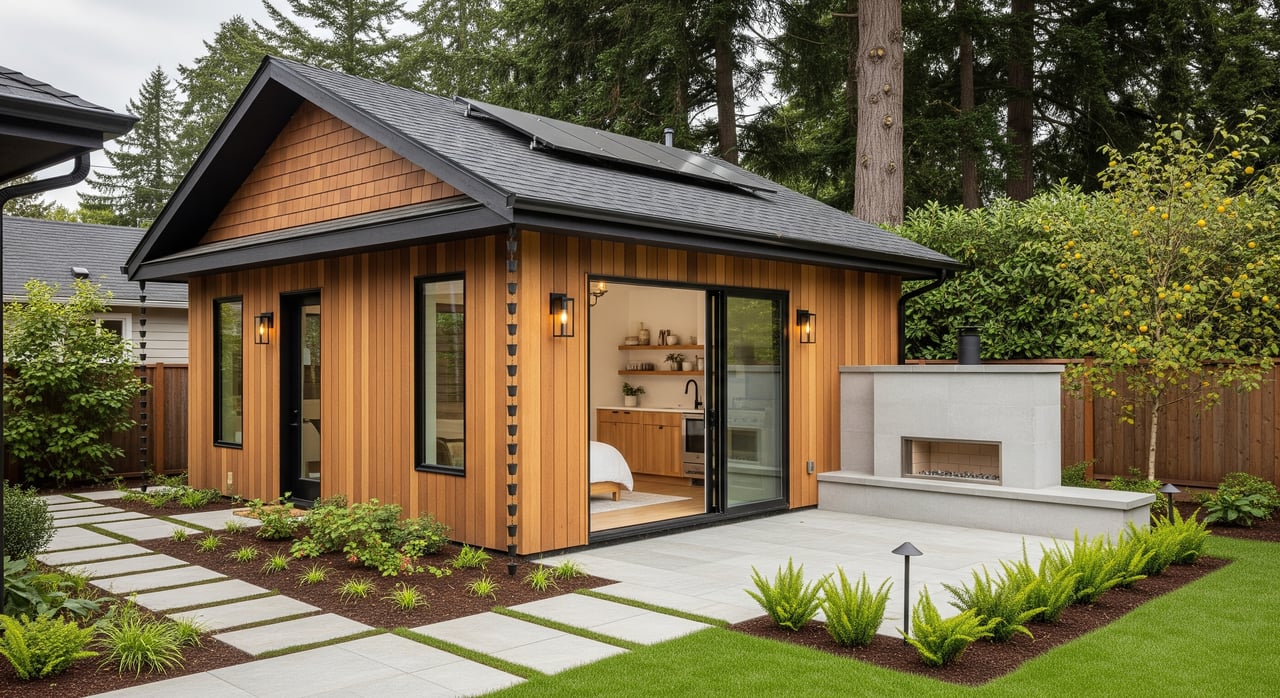
Thinking about adding a backyard cottage or converting space into a rental in Camas? You are not alone. Many Clark County homeowners see an accessory dwelling unit as a way to create family flexibility or generate income. In this guide, you will learn what to check in Camas rules, how to budget for costs, how long permitting and construction usually take, and simple ways to model your return. Let’s dive in.
ADU basics in Camas
An accessory dwelling unit is a smaller, independent home on the same lot as your primary house. In Camas, you will want to confirm where ADUs are allowed, what size and types are permitted, and how parking, setbacks, and design standards apply on your specific lot. Washington State has encouraged ADU development in recent years, and local rules have continued to evolve, so it is important to verify the latest details with City staff before you start.
Key rules to confirm
Before you spend on plans, contact the City of Camas Planning and Building teams to confirm:
- Allowed zones and process: whether ADUs are allowed by right in your zone or need a special review.
- Types: attached, detached, garage or basement conversions, and any differences in standards by type.
- Size: maximum square footage or percentage of the main home, and whether attached and detached units have different caps.
- Height and design: height limits for detached units and any design compatibility requirements.
- Setbacks and lot coverage: distance from property lines and total lot coverage limits that affect placement.
- Parking: whether on-site parking is required or exempted for ADUs in your situation.
- Owner-occupancy and rental limits: how current state law affects any local owner-occupancy rules and whether short-term stays are limited.
- Fees: impact, park, and traffic fees if applicable, plus water, sewer, and electrical hookup requirements.
- Building and life-safety: code items such as egress, smoke detectors, ventilation, ceiling height, and energy code compliance.
- Utilities and special districts: whether your property uses city sewer or septic and what that means for approvals and costs.
- HOA covenants: any neighborhood restrictions that are more limiting than city code.
What an ADU costs in Camas
Every lot and design is different, but you can use these Pacific Northwest ballparks to frame a budget:
- Conversion (basement or garage): about $100 to $250+ per square foot.
- Attached ADU (new addition): about $200 to $400+ per square foot.
- Detached ADU (standalone): about $250 to $500+ per square foot.
Your total cost includes more than framing and finishes. Plan for design and engineering, permits and reviews, site work and foundation, the building shell, mechanical systems, interior finishes, utility connections, site improvements, and a contingency. A 10 to 20 percent contingency is commonly recommended to cover surprises.
Cost drivers to watch
A few items tend to push budgets higher:
- Major utility upgrades like a new electrical service panel, long sewer or water extensions, or septic system work.
- Challenging sites that need drainage, retaining walls, or slope work.
- Structural changes to the main house for attached units.
- High-end finishes and complex design features.
- Small-size inefficiencies, since kitchens, baths, and mechanicals carry fixed costs.
- Busy local construction conditions that raise bids and extend schedules.
Build a realistic budget
Use a simple, step-by-step approach to tighten your estimate:
- Confirm what you can build. Ask the City about ADU type, size, height, setbacks, and parking on your lot.
- Get design input. Request quotes from 2 to 3 architects or design-build firms to define scope and likely per-square-foot costs.
- Check utilities early. Ask providers about water, sewer, electrical, and gas needs plus any hookup fees.
- Seek multiple contractor bids. Once you have preliminary plans, get at least 2 to 3 bids with line items and allowances.
- Add soft costs and contingency. Include design, surveys, permits, and a 10 to 20 percent contingency.
Permits and timeline in Camas
Most projects follow a predictable path:
- Pre-application conversation with Planning to confirm zoning compliance and identify constraints.
- Site plan and design development including floor plans, elevations, and required engineering.
- Permit submittal for building, planning review if needed, and any public works or utility permits.
- Plan review cycles where the City checks for code compliance and may request revisions.
- Permit issuance after approvals and fee payment.
- Construction with scheduled inspections at foundations, framing, rough-in mechanicals, and final.
- Final inspection and occupancy sign-off.
Typical timelines vary by scope and City workload:
- Pre-application scheduling: about 1 to 4 weeks.
- Design and engineering: about 4 to 12+ weeks.
- Plan review: about 2 to 8+ weeks, longer if multiple review cycles are needed.
- Construction: about 3 to 6 months for modest projects, up to 6 to 12 months for larger or complex builds.
From idea to move-in, many homeowners see a 6 to 18 month journey. Give yourself time and budget space for corrections and inspections.
Financing, taxes, and renting
You have several ways to pay for an ADU:
- Cash from savings.
- Home equity line of credit or home equity loan.
- Cash-out refinance of your primary mortgage.
- Construction or construction-to-permanent loan, common for detached builds.
- Personal or renovation loan for smaller conversions.
Plan for the financial ripple effects too:
- Property tax: adding an ADU typically increases assessed value, which can raise taxes.
- Income tax: rent is taxable income, but certain expenses may be deductible. A CPA can help you plan.
- Insurance: notify your insurer. You may need policy adjustments or additional dwelling coverage.
- Rental rules: long-term and short-term rentals can be treated differently. If you intend short-term stays, verify registration, safety, and tax requirements.
- Operations: decide on separate meters or bundled utilities, set up leases and screening in line with Washington landlord-tenant laws, and plan for parking and safe access.
ROI: what returns look like
You can evaluate an ADU like any rental using a few simple metrics:
- Net Operating Income (NOI) equals annual rent minus operating expenses such as taxes, insurance, maintenance, and management.
- Cap rate equals NOI divided by total project cost.
- Cash-on-cash return equals annual cash flow after loan payments divided by your cash invested.
- Payback period equals total project cost divided by annual cash flow.
Here is a hypothetical example to show the math. Replace the numbers with your local rent comps and actual bids:
- Project cost: $150,000.
- Monthly rent: $1,800.
- Vacancy: 7 percent. Effective annual rent equals $1,800 × 12 × 0.93 = $20,088.
- Operating expenses: assume 30 percent of effective rent, or $6,026.
- NOI: $20,088 minus $6,026 equals $14,062.
- Cap rate: $14,062 divided by $150,000 equals 9.4 percent.
- Financing: 70 percent loan at 5 percent for 30 years. Estimated annual debt service about $6,900.
- Annual cash flow: $14,062 minus $6,900 equals $7,162.
- Cash-on-cash return: if you invest $45,000 in cash, $7,162 divided by $45,000 equals 15.9 percent.
These figures are purely illustrative. Your outcome depends on real Camas rent levels, accurate project costing, and your financing and tax treatment.
Pre-project checklist
Use this quick list to keep your ADU project on track in Camas:
- Confirm zoning, size, and siting rules with City Planning.
- Check utilities and expected hookup or upgrade costs.
- Order a site survey and create a schematic design.
- Collect multiple contractor bids with clear allowances and timelines.
- Model ROI with conservative rent and expense assumptions, and review financing with your lender.
- Ask a CPA about taxes and deductions.
- Review insurance needs and any HOA covenants.
- Submit permits and build in time for reviews and corrections.
Is an ADU right for your goals?
If you want flexible space for family or a steady long-term income stream, an ADU can be a smart, value-adding improvement. The keys are verifying what is allowed on your lot, building a realistic budget, and running the numbers with conservative assumptions. With the right plan, you can create a high-quality living space that fits your property and future plans.
If you would like local perspective on how an ADU might impact your home’s value and marketability in Camas or greater Clark County, reach out to Joy Johnson. You will get clear guidance, practical next steps, and a stress-reducing plan tailored to your property.
FAQs
Are ADUs allowed on my Camas property?
- Many single-family lots allow ADUs, but size, setbacks, height, and parking rules vary by zone and site conditions. Confirm details with Camas Planning using your address.
How much does a Camas ADU typically cost?
- Recent Pacific Northwest ranges run about $100 to $500+ per square foot depending on whether it is a conversion, attached, or detached build, plus soft costs and a contingency.
How long will permitting and construction take in Camas?
- From concept to move-in, many projects take 6 to 18 months. That includes design, plan review of 2 to 8+ weeks, and construction of 3 to 6 months or more.
Do I need extra parking for an ADU in Camas?
- Parking requirements can depend on your lot and zoning. Ask Planning how ADU parking is treated for your address and whether any exemptions apply.
Will I need to upgrade utilities for an ADU?
- Possibly. Common upgrades include electrical panel capacity and water or sewer extensions. Septic properties may need system evaluation or improvements.
What kind of rent and ROI can I expect from a Camas ADU?
- Use local rent comps, a 5 to 10 percent vacancy assumption, and 20 to 40 percent operating expense range to model NOI, cap rate, and cash-on-cash return based on your costs and financing.